
Digital Collecting Practices
How our cross-cultural desire to collect things manifests online

Collecting has been something I’ve been drawn towards from an early age. When I was around six, I started a sticker collection on my bedroom door - which mostly consisted of ‘Good Job!’ stickers from the dentist. This evolved over the years into collecting any interesting looking paper items I came across, from cinema tickets to exhibition postcards. As a Gen Z child growing up on the internet, this passion for collecting also crossed over into the digital realm when I was in my tweens. When I was 13, I was given the first Rookie Yearbook, which started my obsession with the (now defunct) online teen magazine. Over the next year, I collected together my favourite images from the Rookie website, often gauzy photo shoots of teen girls in American Apparel tennis skirts staring vacantly into the middle distance, alongside images of tarot cards and Wes Anderson films. I printed the pictures out and displayed my collection on my bedroom walls, bringing my digital obsessions into the physical world.
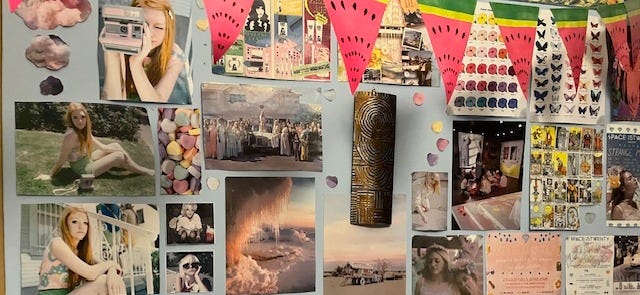
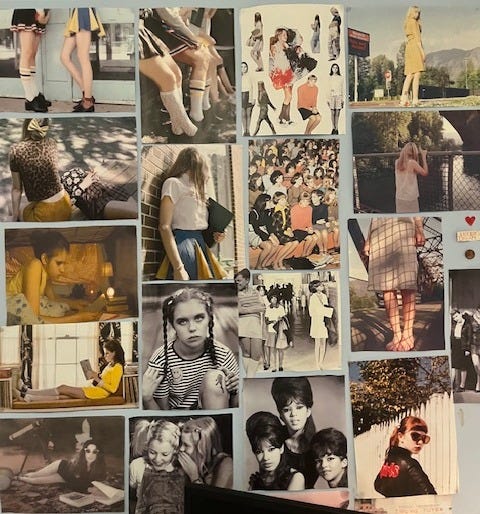
Selections from my bedroom wall ‘collection’ of Rookie images
At the same time, I started my Pinterest account. Returning to the platform in my early 20s, it was striking how of their time my pins of the 2010s were, featuring outfits made up of wide brim hats and top buttoned shirts, fishtail braids, floral Crosley record players and frozen yoghurt. I am intrigued by the renewed 2020s interest in these spaces for online collection, especially as we consider our relationship with the dominant social media platforms and the digital artefacts they create. At this time of year, when my social media feeds are saturated with content about 2025 vision boards and manifesting intentions for the new year, this desire to accumulate and organise visual content to create meaning and purpose appears particularly significant.
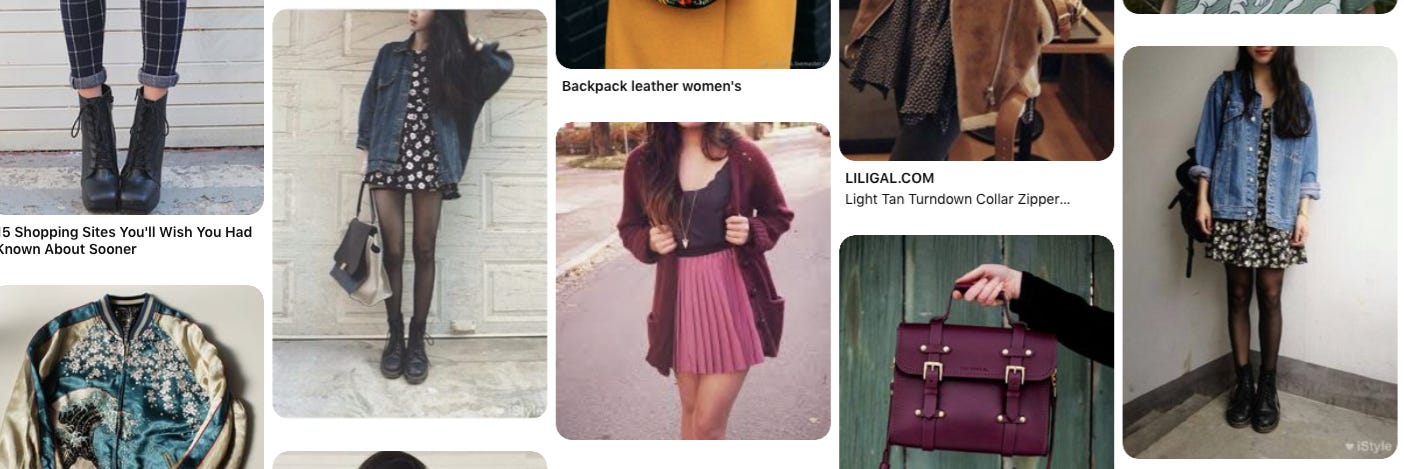
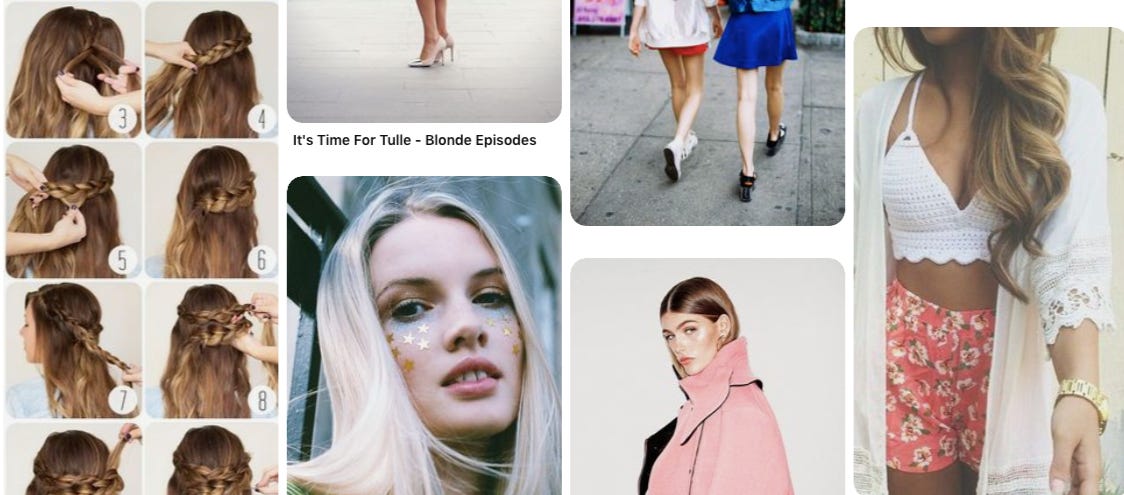
Some deep cuts from my ‘Fashion’ Pinterest boards of the 2010s
Collecting is an essential part of ‘online culture’, a practice inherent to the digital infrastructure that governs our online lives. As Yoni Van Den Eede argues in his article Collecting Our Lives Online: The Use of Digital Media Seen through the Lens of Collecting Practices, “our online activities – centered on selecting, accumulating, organizing, and showing – strongly resemble the practice of collectors” (Van Den Eede 2010: 104). The extent to which we are aware that we are engaging in the practice of collecting - creating “a set of objects that forms some kind of meaningful though not necessarily (yet) complete “whole”” (MacDonald 2006: 82) - can vary however.
Digital collecting practices can be especially unconscious when they take the form of companies collecting data on us, a practice that fuels and funds the majority of our social media interactions. At the same time, more consciously used features like bookmarking, saving and archiving encourage us to build up digital collections of content, becoming an increasingly unwieldy and overwhelming to-do list of media and information consumption. Like the notification number in the top right of an app icon, these features allude to an ideal future where we get to all our self-assigned ‘tasks’ of interaction and engagement, where we ‘clean’ the mess of the internet.
Algorithms themselves can be seen as a digital collecting practice, something that is even being referred to as curated and compiled, e.g. people saying ‘I’ve really created the perfect algorithm’ through extended time on a platform. At the same time, these algorithms can be seen to collect us, fitting us and our tastes into hyper-specific categories. This raises the question: do we curate our digital experiences or are we curated by them? This query becomes especially salient when people start to notice people ‘irl’ starting to wear the same fashion item or use the same phrase that appears to exclusively originate online, prompting a million ‘the death of personal style’ essays. I believe this backlash can result in a fruitless search for a version of the self entirely uninfluenced by outside pressures, one that is unrealistic given that people have always been influenced by external cultural factors. On the other hand, the cultural phenomenon of hyper-specific online aesthetics does owe some of its origins to the emphasis on collection, conscious and unconscious, in our digital lives.
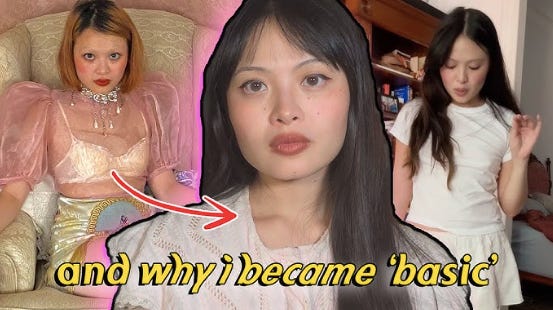
Thumbnail from Mina Le’s ‘the death of personal style’ video essay
I recently came across a video from the Instagram page @aview.fromabridge, where participants share a particular perspective or ‘hot take’ while being filmed in a zoom-out shot from a real-life bridge. In this video, the speaker critiques an impulse they have observed for young people, at least in the creative circles of major cities, to be increasingly focused on being culture producers, rather than participants - i.e. ‘everyone is a DJ now’. I was struck by the speaker saying “everyone’s so concerned about organising and preparing and actualising this version of themselves that’s supposed to be a cultural artefact that they forget to go out and have fun”. The pressures of online existence can cause us to make ourselves into artefacts that we curate and collect. Instagram photo dumps, Pinterest mood boards and Tumblr reposts are all small curations of the vast amount of visual ephemera that we create and are exposed to, which play into the (typically feminised) labour of aestheticising our lives.

From the Instagram page @aview.fromabridge
I wanted to explore some of the anthropological literature on collecting and collections, to understand this human instinct to bring things together and make meaning from them from a cross-cultural perspective. Anthropology and psychoanalysis have often converged to look at collecting as an extension and expression of self. Baudrillaud argued that in the act of collecting, ”It is inevitably oneself that one collects” (Baudrillard 1994:12), with the (inexhaustible) desire to complete a collection mirroring the (equally unbounded) desire to complete oneself. Baudrillard also theorised links between collecting and sexuality, positioning collecting as a regression by returning to inanimate (and thereby sexless) objects as objects of attachment. In an increasingly fraught dating landscape, I can believe Pinterest is taking some of the brunt of our generation’s desire for connection, to create romance through curated aesthetic fantasies.
In the new year push to collect together words and images in vision boards, we can see another framing of collecting as an expression of self and means to self-actualisation. In The Culture of Collecting, Elyse Speaks traces the rise of collecting in the US and UK with the increase in mass manufacturing. Speaks shows how the more widespread availability and standardisation of goods in industrialised societies enabled collecting to be formalised as a pastime, with systems of categorisation and classification that established rules for the status of objects. She also argues that collecting’s idealisation as a hobby in the mid-20th century exposes “the tension at the heart of many leisure-based activities that seemed all too much like substitute forms of professional labour”. Collecting is tied to patterns of consumption and of labour, with accumulation inherent to its practice and the success of a collection often being defined by its growth in objects, giving collecting a clear end goal and purpose. The contemporary instrumentalisation of collecting practices, like vision boarding, as a means of self-improvement can be seen as one of the ways we make hobbies into another avenue of labour. These ‘hobbies’ enable us to continue to be productive workers, by being goal-oriented even in our leisure time.
At the same time, Speaks also shows how artists have challenged this productive framing of collections to “assert the possible connections that hobbies, as a kind of personalised labour, might have to freedom, intimacy, imagination, and tactility over and above any sort of marketable outcome”. By conserving objects, rather than disposing of them, collecting can act as a means to “reject the world of accepted material values”, even for an inherently materialist practice. This ability to set one’s own terms of value and to curate worlds for oneself through collection can make collecting a creative and imaginative practice.
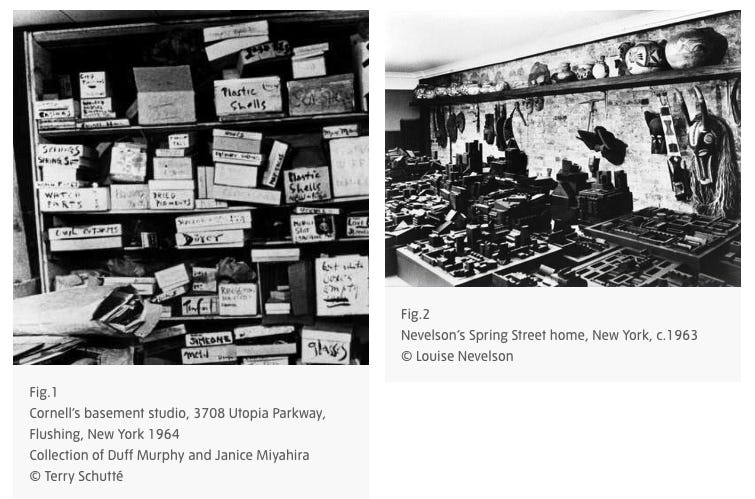
Speaks’ examples of artists Joseph Cornell and Louise Nevelson’s unusual collections
This imaginative potential of collecting is often seen in its manifestation as nostalgia, of capturing the past through artefacts. Collecting can be a defence mechanism against a changing world by constructing an image of an ideal past. At the same time, collections are always a fragile medium in which to conserve the past, whether tangible or intangible. In a digital context, this fragility is being exemplified through concerns about ‘digital rotting’, with dead links and websites serving as a reminder of the vulnerability of the internet as a means of archiving and collection.
Collecting is also imaginative because it is a process of narrative, of giving meaning to objects through their relations to each other. This narrativisation is enabled through the abstraction and decontextualisation of objects in collection, removing objects from everyday functionality and giving them new meaning. As the online world is already detached in many ways from time and space, it lends itself to this abstraction and decontextualising that underpins dominant collecting practices.
However, there is potential to bring greater tangibility and animation to collecting practices online. Indigenous models of collecting provide examples of ways to keep objects ‘alive’ and tied to their cultural worlds. In Liberating Culture: Cross-Cultural Perspectives on Museums, Curation and Heritage Preservation, Christina Kreps looks at indigenous modes of preserving cultural heritage. For example, she discusses the preservation of pusaka (heirlooms) in Indonesia in communal spaces, such as in longhouses (tilung pu’un) or granaries and rice barns (lumbung) where rights to pusaka are tied to particular families or individuals. Objects are more likely to be seen as “ensconced in their larger cultural contexts, and in direct relationship to people’s lives as part of ongoing cultural traditions” (Kreps 2003: 148).
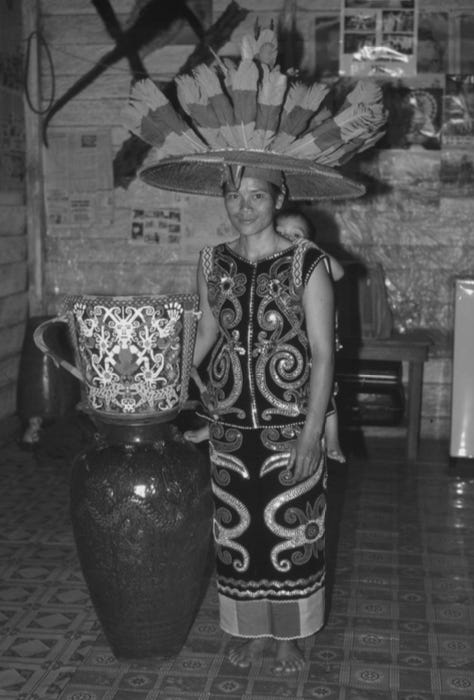
Kenyah Dayak woman of East Kalimantan, Indonesia, displaying her pusaka (heirlooms). Photograph by Christina Kreps (1996), featured in Liberating Culture (2003), pp. 55.
This relational view of objects can also tie into a sense of objects being ‘animated’ or alive, with sacred energies that must be preserved through ritual treatment. The spiritualism of collection can be seen transposed into the digital realm, with certain digital subcultures of visual collection (often driven by young women) like yearnposting and girl blogging infusing the collecting and curating of images with spiritual essence. The unpredictability and intangibility of encounters with online content is made sense of through a lens of fate and destiny, that claims that ‘if you are seeing this, it is meant for you’.
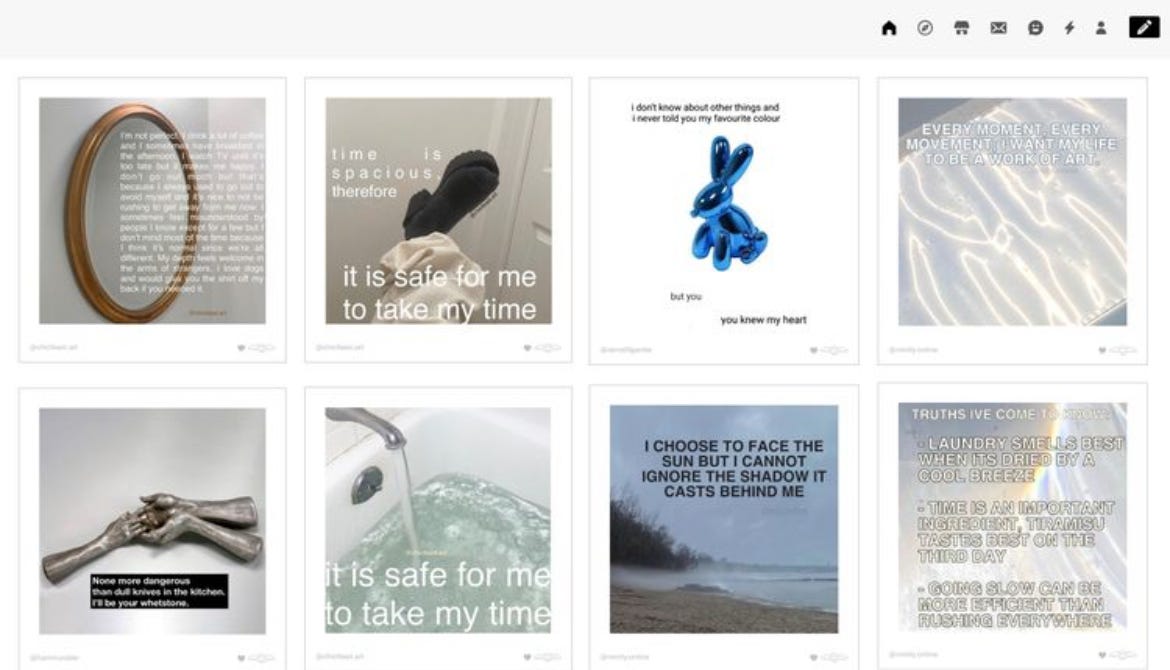
Examples of yearnposting, found from this article
This search for greater meaning in the processes of selecting, ordering, looking at, accumulating and constructing digital collections relates to a broader desire for more magic and a sense of discovery in our online lives. The siloing and specification of algorithms and dominance of advertising on conventional social media platforms makes delayed gratification in the digital collecting experience a far rarer experience, as part of their streamlining and colonising of our attentional resources.
I have been seeing more conversation around alternative digital collecting platforms, such as those detailed in the Youtube video the truth about pinterest (& better alternatives), currently at 282k views. In the video, the creator eliznuts expresses her frustration with the ad-heavy nature of Pinterest and suggests less algorithmically driven and commercialised platforms to find creative inspiration. One of the recommendations she makes is Are.na, a platform I am very intrigued by and that I referenced in this article on play on my other Substack semi-precious, as part of my point that collection - even in the form of research - is a form of play. I like the more self-driven form of exploration enabled by the design of these (currently) less commercialised platforms, like Cosmos and Are.na, connecting users to the thrill of the ‘hunt’ for the perfect object or piece of information.
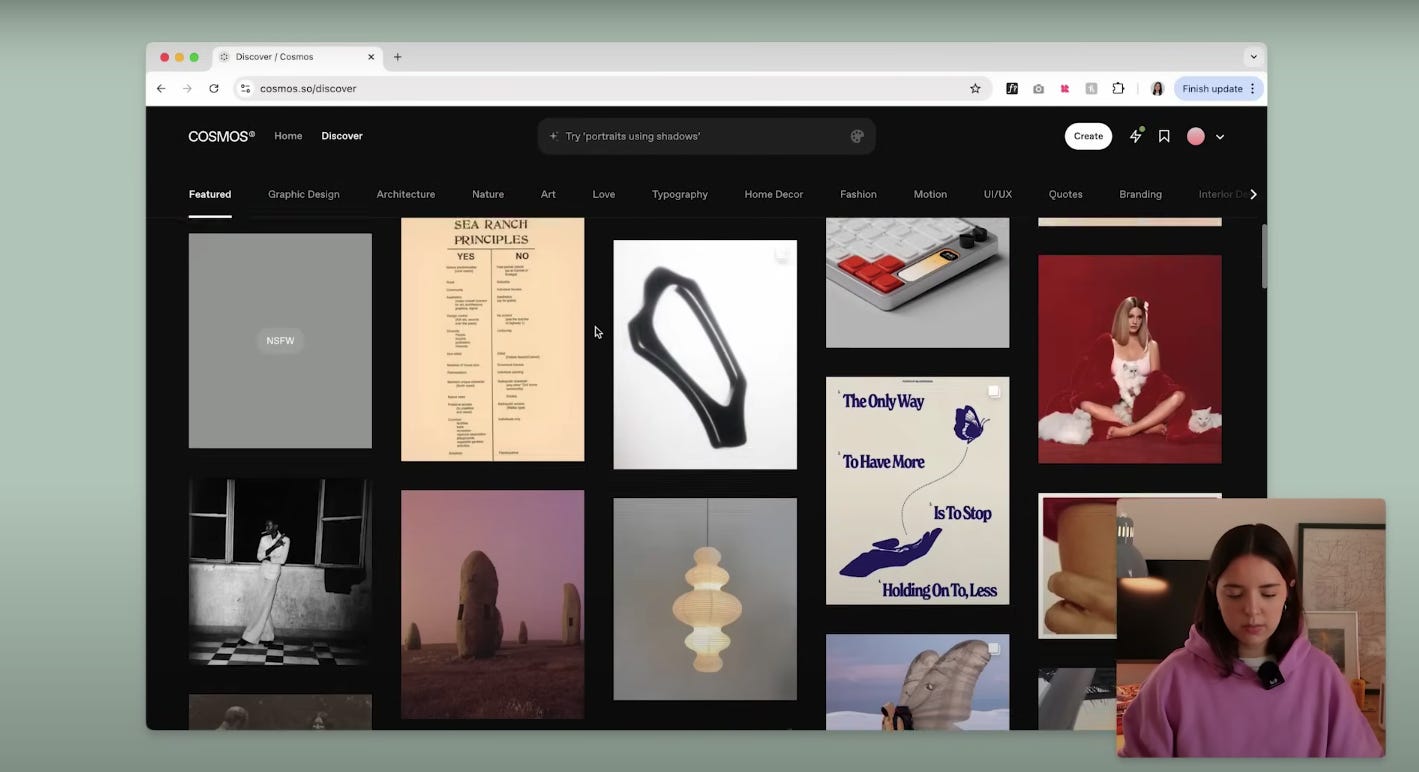
Still from the video the truth about pinterest (& better alternatives), showing Cosmos
Of course, the greatest move away from algorithms and advertising is to embrace analogue collecting practices instead. Journaling, mood boarding and scrapbooking using physical media is increasingly popular, reflecting a broader desire to reduce screen time and detox from the online world, even if the initial interest for these activities arises online. Recently, one of my favourite Youtubers, Cam Does It, started her project SOMNI, which promotes capturing our lives physically through scrapbooks and journals. I was intrigued, not just by the project itself, but also what it represents about the renewed interest in these analogue practices and what they mean for the future of collecting. We may still take photos or encounter our initial inspiration through digital technologies, but there is more interest in investing time and resources to make these memories tangible and long-lasting.
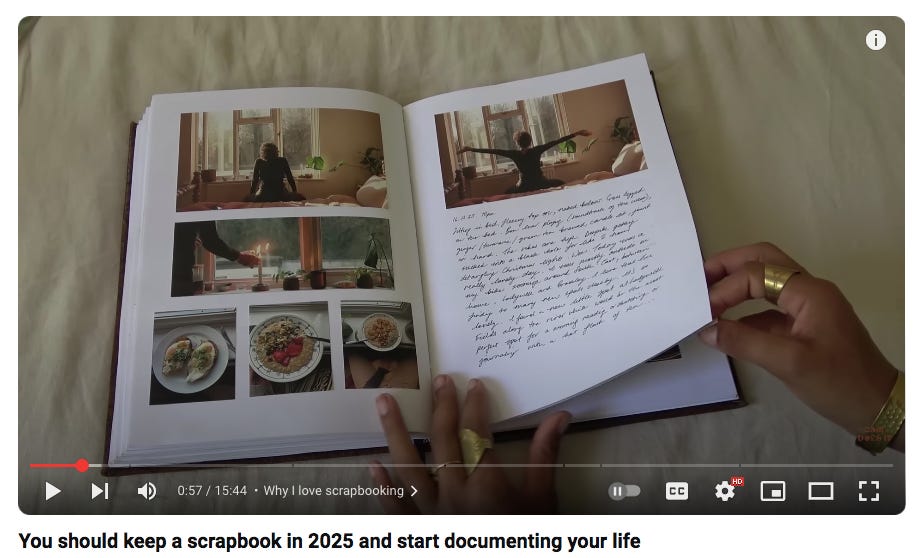
Still from Cam’s recent video on scrapbooking
As a cross-cultural human practice, collections reveal what we believe is deserving of preservation and memory. Therefore, in the collecting itself, we can examine the processes by which we make meaning of the ephemera we encounter in our lives and how this shapes our own sense of ourselves, individually and culturally. In an increasingly over-stimulating digital (and physical) environment, having greater agency over our collecting practices might enable us to better collect ourselves, too.
Bibliography (extended texts)
Baudrillard, J. (1994). Simulacra and Simulation. Ann Arbor, MI: The University of Michigan Press.
Kreps, C. (2003). Liberating Culture: Cross-Cultural Perspectives on Museums, Curation and Heritage Preservation. London: Routledge.
Macdonald, S. (2006). ‘Collecting Practices’ in Macdonald, S. (ed.) A Companion to Museum Studies. Oxford: Blackwell Publishing Ltd, pp. 81-97.
Speaks, E. (2016). ‘The Culture of Collecting’, in Black Wall 1959 by Louise Nevelson, Tate Research Publication. Available at: https://www.tate.org.uk/research/in-focus/black-wall-louise-nevelson/culture-of-collecting (Accessed: 27 January 2025).
Van Den Eede, Y. (2010). Collecting Our Lives Online: The Use of Digital Media Seen through the Lens of Collecting Practices. Techné 14 (2), pp.103-123.
I really really loved this!